
The moment a prospective client walks into your law firm, they begin forming an opinion. Before you have said a single word, before they have reviewed your case record or your bio, the space itself is already speaking. It communicates your attention to detail, your standards, and your standing.
For law firm partners in Virginia, interior design is not an aesthetic luxury. It is a business development asset. The firms that understand this are investing in environments that do serious professional work: they convert consultations into retainers, reduce client anxiety, and position the firm as the clear choice before the conversation even begins.
At Statement Design Concepts, we design law firm interiors across Virginia that are purposeful, authoritative, and built around how modern legal practices actually operate. This guide walks you through what great law firm design accomplishes and how we approach it for firms like yours.
Why Law Firm Design Is a Business Development Tool
Most law firm partners think about business development in terms of referrals, reputation, and marketing. Rarely does office design make the list. But research on environmental psychology consistently shows that physical surroundings shape how people feel, how much they trust the person they are meeting with, and how confident they feel in the decisions they are about to make.
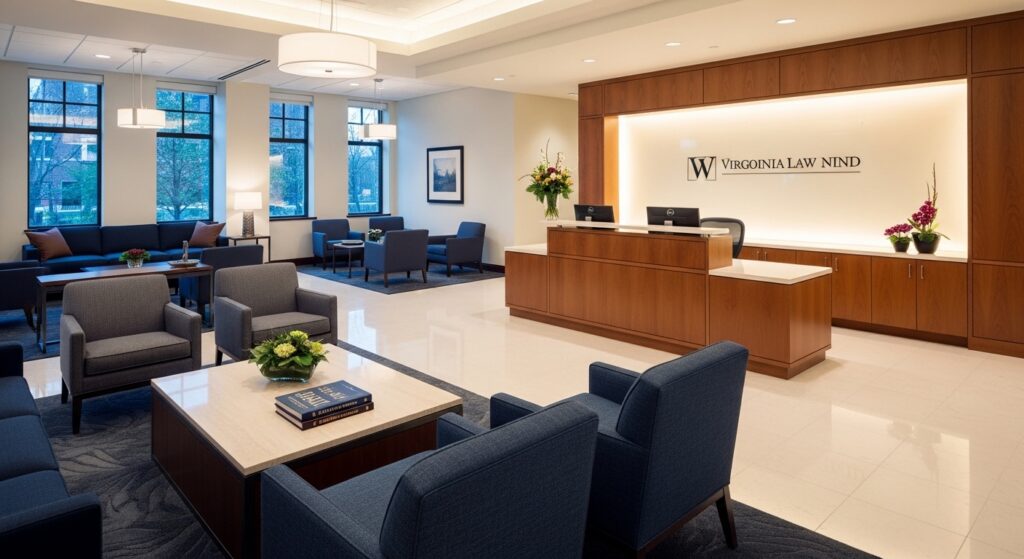
Consider what happens during a high-stakes client consultation. A prospective client arrives carrying stress, uncertainty, and often a significant financial decision. The physical environment either amplifies that anxiety or calms it. A well-designed reception area, a thoughtfully appointed conference room, and a private, acoustically sound meeting space all signal the same thing: we take your situation seriously, and we have the resources and the attention to detail to handle it.
Here is how strategic interior design directly supports law firm growth:
- Stronger first impressions that increase the likelihood of a prospect signing on during or after the initial consultation
- Reduced client anxiety in reception and waiting areas, leading to more productive meetings
- A space that communicates firm culture, values, and seniority without a word being spoken
- Improved attorney productivity and morale through well-planned, ergonomically sound workspaces
- A competitive differentiator when prospects are comparing two or more firms of similar size and reputation
In a profession where trust is the product, your office is part of the pitch.
Our commercial interior design services for Virginia are specifically designed to support professional environments where client perception and operational performance both matter.
What Clients Notice When They Walk Into Your Firm
You cannot unsee a first impression, and clients form theirs within seconds of walking through the door. Understanding exactly what they are registering helps you design with intention rather than guesswork.
Based on our experience designing professional environments across Virginia, here are the elements clients consistently notice and respond to:
Reception and Entry
- Lighting quality: harsh fluorescent lighting signals budget and inattention; warm layered lighting signals care and investment
- Seating comfort: uncomfortable chairs in a waiting area prime clients for impatience before the meeting starts
- Visual clutter vs. calm: a disorganized reception area raises subconscious questions about organizational competence
- Signage and wayfinding: clear, well-designed signage tells clients your firm respects their time
Conference and Meeting Rooms
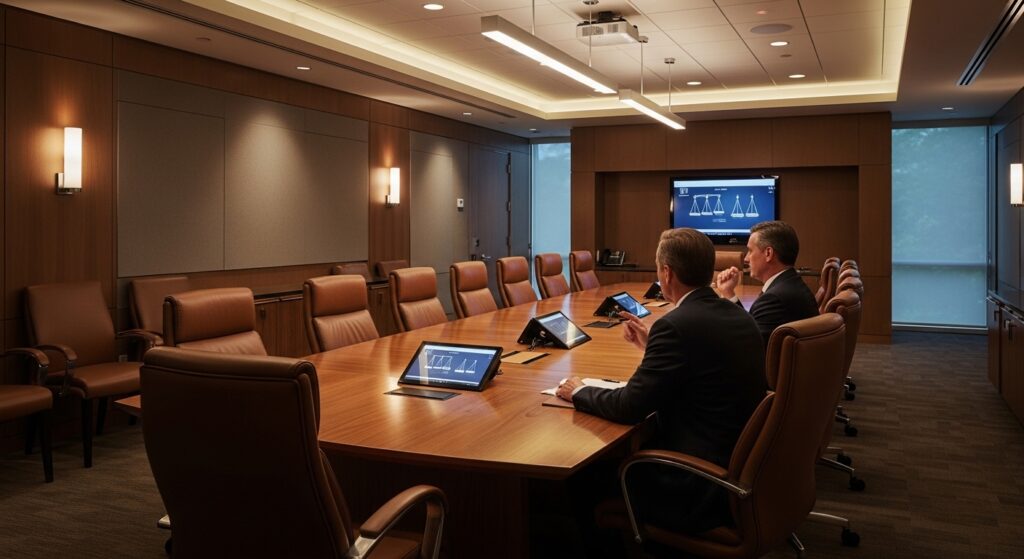
- Table proportion: a table that is too large for the room creates distance; one that is too small feels casual
- Acoustic privacy: if clients can hear conversations from adjacent offices, they wonder whether their conversation is equally exposed
- Technology integration: hidden cable management and seamlessly integrated AV signal, modern operational competence
- Material quality at touch points: the texture of the conference table, the weight of the chairs, the quality of the materials clients actually touch
Attorney Offices
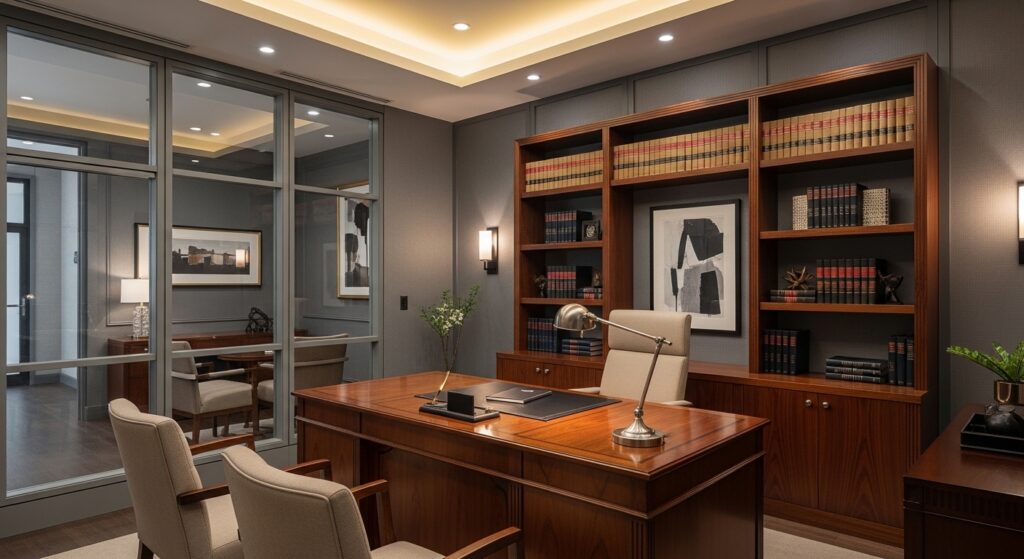
- Bookshelves and credenzas that are curated, not chaotic
- Desk positioning that reflects authority without creating unnecessary distance
- Lighting that makes the attorney look confident and engaged, not washed out or shadowed
None of these observations is superficial. Each one connects to a deeper client judgment about professionalism, competence, and trustworthiness.
Key Elements of Effective Law Office Interior Design
Great law firm design is not about decorating. It is about engineering an environment that works for the people inside it and signals authority to the people visiting. The following are the core design decisions that separate effective law firm spaces from generic office interiors.
Color Strategy and Material Selection
Law firm interiors traditionally draw on a palette of deep navy, charcoal, warm white, and rich wood tones because these colors are associated cross-culturally with authority, stability, and trustworthiness. This does not mean every law firm should look the same. A well-designed Virginia law firm can express its distinct identity within this framework through material choices, texture, lighting, and art selection.
Materials matter at every touch point. Solid wood conference tables, leather or performance-fabric upholstery, stone or high-quality composite surfaces, and brushed-metal hardware all contribute to an overall impression of quality that clients register, even when they cannot name exactly what they are responding to.
Layout and Space Planning
Space planning in a law firm must address several competing needs at once: open enough for collaboration, private enough for confidential conversations, impressive enough for client-facing areas, and functional enough for the daily work of legal practice.
Common layout priorities we address for Virginia law firms include:
- Separating high-traffic client zones from attorney work zones to reduce disruption
- Designing reception areas with clear sightlines and a sense of controlled arrival
- Ensuring conference rooms have true acoustic separation from adjacent spaces
- Building in flexible meeting spaces for firms that need to scale up or reconfigure over time
- Creating partner offices that feel distinguished without being isolated from the rest of the team
Lighting Design
Lighting is one of the highest-leverage investments in any commercial interior and one of the most consistently underestimated. In law firm environments, a well-designed lighting scheme serves three purposes: it makes people look and feel their best, it reduces eye strain during long document-intensive workdays, and it sets the environmental tone for client interactions.
We design law firm lighting systems with separate circuits for ambient, task, and accent lighting, all on dimmers, so that conference rooms can shift from a bright working session to a calm, intimate consultation with a simple adjustment.
Branding and Identity Integration
Your firm’s visual identity should extend into the physical environment in a way that feels intentional rather than forced. This means incorporating firm colors and identity elements through material selection, art curation, and architectural finishes rather than through literal logo placement on every wall. The result is a space that feels specifically yours rather than a generic law office with your name on the door.
Our Work: Virginia Law Firm Transformations
The proof of any design philosophy is in the completed project. At Statement Design Concepts, we have helped Virginia law firms transform underperforming office spaces into environments that actively support the firm’s growth and reputation.
Our projects have ranged from single-floor reconfigurations for boutique practices to full multi-floor commercial fit-outs for regional firms. In each case, the brief is the same: create a space that makes clients feel confident they are in the right place and makes attorneys proud to bring them there.
What our clients tell us:
“We noticed the difference in our consultations immediately. Prospects who came in uncertain left feeling like we were the obvious choice. The space made that happen before we even started talking.”
If you would like to see the specific design decisions behind our commercial projects, browse our Virginia interior design portfolio for a closer look at our work and the results our clients have experienced.
Designing for Confidentiality and Professionalism
Law firm design presents a set of requirements that are specific to the legal industry. Chief among them is the need to protect client confidentiality at every level of the built environment. A beautifully designed conference room that allows conversations to bleed into the hallway is not just an aesthetic failure. It is a professional liability.
We build confidentiality into every law firm project we undertake through the following design strategies:
1. Acoustic engineering in conference and meeting rooms using sound-rated wall assemblies, acoustic ceiling treatments, and white noise systems where appropriate
2. Glass partition specifications that provide visual transparency without sacrificing acoustic privacy
3. Reception area layout that prevents overheard intake conversations between clients and staff
4. Private consultation alcoves for firms that handle sensitive family law, criminal defense, or high-net-worth matters
5. Technology placement that keeps client information off screens visible to others in shared or waiting areas
Professionalism in design also extends to the sustainability and longevity of the materials we specify. We select finishes that maintain their quality over years of daily professional use, because a law firm that looks worn and dated within five years of a renovation communicates the same thing as one that never renovated at all.
We also work closely with law firm leadership to understand how the firm is evolving. A practice that is scaling quickly needs built-in flexibility. A firm repositioning toward higher-value clientele needs a space that supports that repositioning. Good design anticipates the next three to five years, not just the day of installation.
If your Virginia law firm is ready to have a serious conversation about what your space is communicating to clients, contact our commercial design team to discuss your project and goals. We are ready when you are.
Schedule a Consultation for Your Virginia Law Firm Redesign
Your firm has invested years in building a reputation. Your space should reflect it. We work with Virginia law firms of all sizes to create offices that convey authority, earn client trust, and support how your team actually works.
Get started today: schedule your law firm design consultation and let us show you what is possible.