
The word ‘luxury’ is one of the most overused terms in the interior design industry. Every designer with a high price tag claims it. Every showroom attaches it to their marketing. But genuine luxury residential design — the kind that transforms a Northern Virginia home into something that feels entirely its own — is defined not by cost alone, but by a specific set of standards, relationships, and skills that separate truly high-end work from everything else.
If you are searching for the best luxury interior designer in Northern Virginia or the Washington, DC area, this guide will tell you exactly what to look for, what 2026’s most sought-after design directions look like in this market, and why custom always wins at the premium end. If you want to see the standard before you read any further, start with our interior design portfolio.
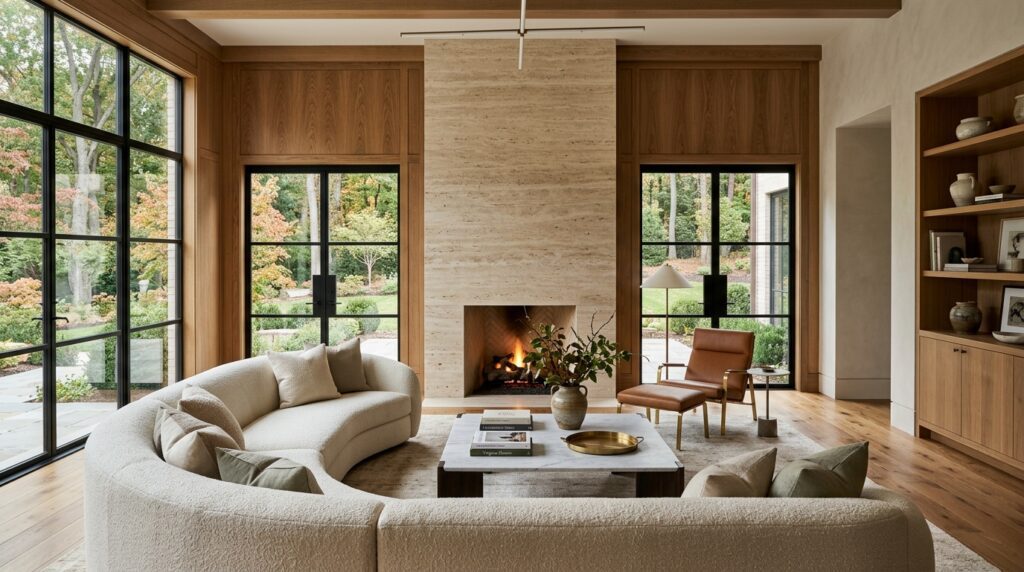
What Actually Defines ‘Luxury’ in Interior Design
Luxury interior design is not a price bracket. It is a methodology, a way of approaching every decision in a project with a standard of quality, customization, and attention to detail that has no shortcut. Three principles run through every genuinely high-end residential project, regardless of style or budget level:
1. Everything Is Made for the Space
In luxury design, “bespoke” is not an upgrade; it is the default. Furniture is scaled to the specific room, not chosen from a catalogue and hoped to fit. Storage is designed around how the client actually lives, not how a manufacturer imagines people store things. Custom joinery, made-to-measure upholstery, and artisan finishes are standard, not exceptional.
2. Materials Are Chosen for Longevity, Not Trend
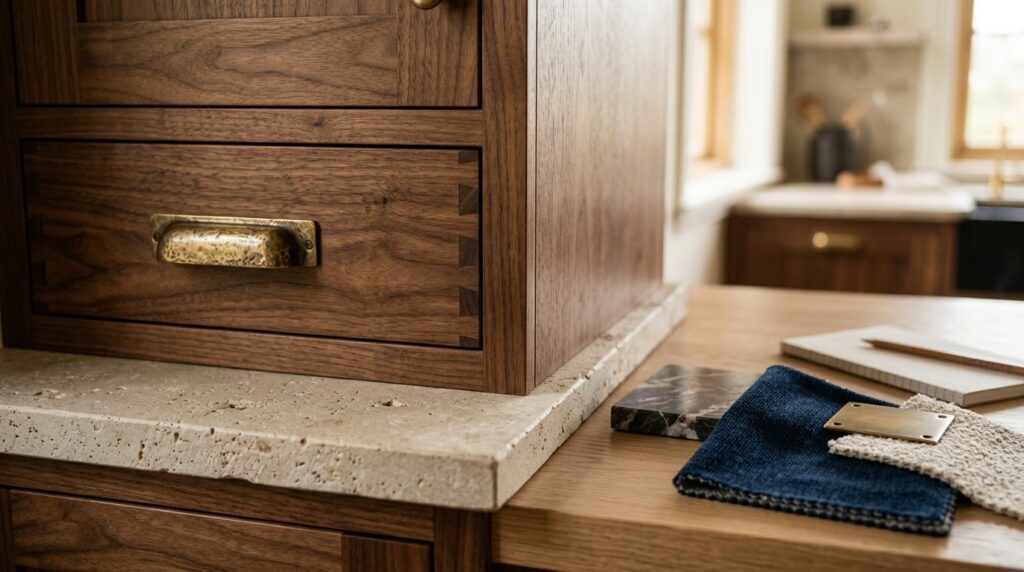
A luxury designer does not reach for what is fashionable this season. They specify what will still look extraordinary in twenty years — honed limestone, solid hardwood, hand-tufted wool, aged brass. These materials have a depth and patina that manufactured alternatives cannot replicate, and they form the physical foundation that makes a room feel genuinely premium rather than expensive-looking.
3. The Process Is Completely Managed
Luxury is also about the experience of working with a designer, not just the result. At the high end, every element — contractor coordination, procurement, installation sequencing, quality checking — is handled end-to-end. The homeowner makes beautiful decisions; the designer absorbs every logistical complexity. That is the service.
The table below illustrates where the real differences sit between standard interior design services and a luxury full-service engagement:
| Design Element | Standard Service | Luxury Full-Service |
| Design Process | Template-driven, trend-led | Bespoke from day one — your brief, your architecture, your life |
| Sourcing | Retail & high-street trade | Exclusive trade-only access, custom makers, international artisans |
| Furniture | Standard catalogue selections | Custom sizing, bespoke upholstery, one-of-a-kind pieces |
| Project Management | Limited or outsourced | Fully managed — contractor, procurement, installation all in-house |
| Material Quality | Mid-grade, broadly available | Honed stone, hand-tufted rugs, solid hardwoods, artisanal finishes |
| Attention to Detail | Room-level consistency | Millimetre-level precision — every junction, every finish, every reveal |
Luxury Design Trends in Northern Virginia for 2026
Northern Virginia’s luxury residential market has its own rhythm. The homes in McLean, Great Falls, Vienna, and the broader DC corridor are substantial, architecturally varied, and owned by clients who have seen trends come and go. What defines luxury design in this market in 2026 is not what is new — it is what is enduring, executed to an exceptional standard.
Quiet Luxury — Restraint as a Statement
The dominant request across our luxury consultations this year is a move away from maximalism and toward what the design industry calls quiet luxury — spaces that communicate quality through material depth, proportion, and considered restraint rather than visual noise. No feature walls for their own sake. No layering of patterns that compete. Instead: one exceptional piece of stone, one perfectly proportioned sofa, and one work of art that earns its place on the wall.
Warm Natural Palettes with High-Contrast Accents
Warm off-whites, aged linens, natural oaks, and travertine form the base palette in most luxury projects in Northern Virginia this year. The contrast is introduced in small, deliberate doses — a deep lacquered cabinet, a blackened steel window frame, a single jewel-toned occasional chair. The effect is a space that feels calm and grounded but never flat.
Integrated Technology Without Visual Compromise
Smart home technology is non-negotiable in this market. The luxury design challenge is integrating it without letting it define the aesthetic. Recessed speakers, flush-mounted controls, motorized drapery systems that disappear into pelmets, and hidden charging are all now expected components of a high-end Northern Virginia home—delivered without a single visible wire or switch plate that interrupts the design intent.
💡 The most common mistake in luxury projects: spending the budget on the wrong things. A beautifully made sofa in a poorly planned room still fails. Space planning and material specification come first — always.
Considering a full-home transformation in Northern Virginia? Explore our residential interior design services to understand what a bespoke, fully managed project engagement looks like from first consultation to final install.
How to Vet a Luxury Interior Designer Near You
Northern Virginia and the Washington DC area have no shortage of designers who market themselves at the luxury end of the market. Filtering for the firms that genuinely deliver at that level requires asking the right questions before any contract is signed. Use this framework:
| What to Assess | What to Look For |
| Portfolio depth | Do they have completed projects at a comparable scale and quality to yours? Look for cohesion across multiple rooms, not just single hero shots. |
| Process transparency | Can they clearly explain how they charge, what procurement looks like, and who manages contractors? Vague answers here are a red flag. |
| Trade relationships | Do they have established access to premium suppliers, custom workrooms, and specialist trades? This is non-negotiable at the luxury level. |
| References | Are they willing to connect you with past clients at a similar project scale? A confident firm will always say yes. |
| Communication style | Do they listen more than they talk in the first consultation? A luxury designer’s job is to interpret your vision, not impose their own. |
| Local knowledge | Do they understand Northern Virginia’s architectural landscape, planning considerations, and local contractor ecosystem? |
One additional filter worth applying: how does the designer talk about other clients and past projects? Discretion is a core attribute of a luxury firm. If a designer is overly forthcoming with personal details about other clients during your consultation, that tells you something important about how your own project will be handled.
Why Custom Always Outperforms Off-the-Shelf in Premium Homes
There is a moment in almost every luxury project where a client asks whether a retail option could substitute for a custom piece. The answer is almost always no — and the reason is scale, not snobbery.
Premium homes in Northern Virginia tend to have high ceilings, large rooms, and proportions that standard retail furniture was never designed for. A sofa that looks generous in a showroom reads small against a 14-foot ceiling. A dining table that seats eight at standard height feels low in a room with architectural grandeur above it. Custom pieces are sized to the architecture, not manufactured to a mass-market average.
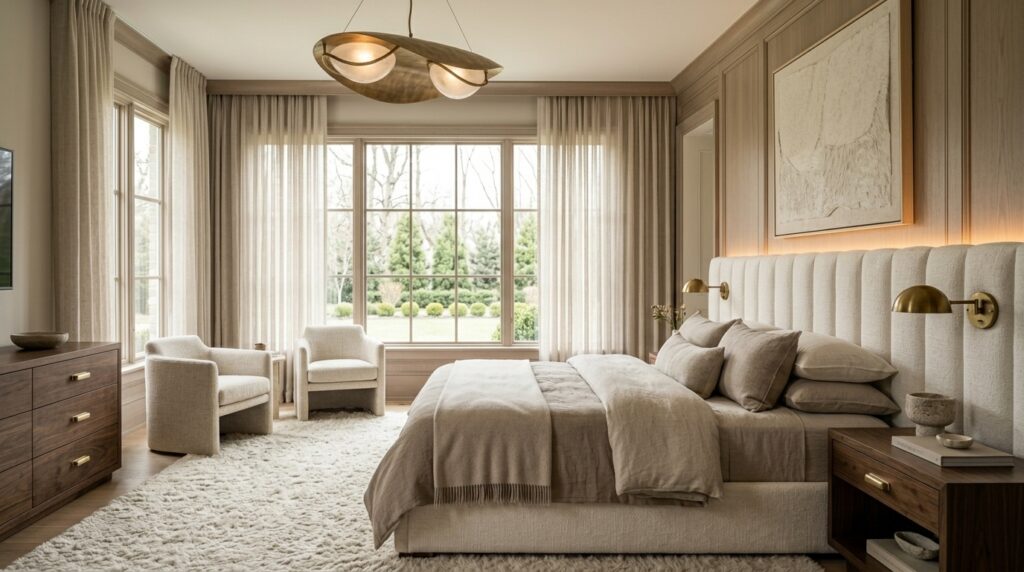
Beyond scale, custom work introduces genuine uniqueness. When a piece is made to specification — a specific timber, a specific stitch, a specific finish — it cannot be replicated in a neighbour’s home or a hotel lobby. That irreducibility is a significant part of what makes a luxury interior feel genuinely personal rather than aspirationally assembled.
• Custom upholstery: fabric selected for the specific light conditions and colour palette of the room
• Bespoke joinery: storage and built-ins designed around how the client actually lives, not a standard module
• Made-to-measure window treatments: proportioned to the exact ceiling height, not hemmed to fit
• Artisan lighting: statement pieces that cannot be found in any catalogue — sourced through relationships built over years in the trade
→ View Our Interior Design Portfolio
→ Book a Free Luxury Design Consultation
Related Reading:
→ Why McLean, VA Homeowners Are Rethinking Their Interiors in 2026→ Residential Interior Design in Arlington, VA: A Complete Homeowner’s Guide