
Key Takeaway
- The through-line across everything that’s working right now is restraint paired with scale. Modern interior moulding isn’t about adding more detail, it’s about choosing fewer, better-proportioned details and running them consistently through a space.
- Before adding trim to any room, look at what’s already there: the ceiling height, the existing baseboards, the doors. The mouldings that work are the ones sized for the room they’re in, not picked off a shelf.
Interior moulding is having its biggest moment in years. After a decade of flat, builder-grade baseboards and bare drywall corners, trim has become one of the most discussed line items in renovation — and the market is expanding alongside it, with the wall-mounted decorative panel market projected to grow from roughly $73.7 billion in 2026 to $89 billion by 2036.
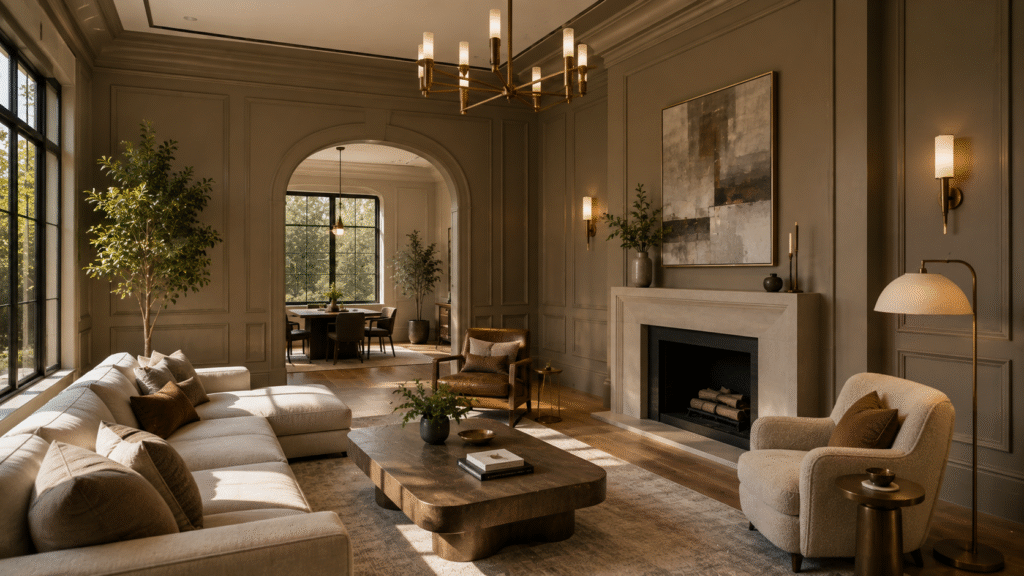
“Moulding is back,” though, doesn’t mean it looks like it used to. The 2026 version is heavier, quieter, and more architectural than the ornate crown detailing of the past. Used well, it gives a room intention and can support resale value. Used carelessly, it dates a space as fast as the trend it was meant to modernise.
This guide covers what’s actually working in modern interior moulding, what falls flat, and whether it’s worth the investment.
Why Interior Moulding Is Trending Again
Several forces are driving the resurgence at once:
- A shift toward “modern heritage”. Designers report growing demand for spaces that feel handcrafted and personal rather than stripped-down and minimal, and trim is one of the fastest ways to add that texture.
- Open-concept fatigue. As open floor plans mature, homeowners are using moulding to reintroduce definition and architectural rhythm without adding walls.
- Renewed respect for craftsmanship. Panelling and mouldings are increasingly used to customise otherwise simple, cost-driven builder spaces — including on cabinetry, where inset moulding is replacing the standard shaker profile.
What Works: Modern Moulding Trends Worth Adopting
Oversized, Square-Edge Baseboards
The single biggest shift in trim right now is scale, not style. Baseboards in the 5–7 inch range, with a clean square or gently eased edge, are replacing the thin, fussy profiles builders defaulted to for years.
- Adds visual weight that grounds a room instead of reading as an afterthought
- Pairs especially well with open-concept layouts and taller ceilings
- Stick to square or eased-edge profiles — avoid ornate, curved detailing here
Colour-Drenched Trim
Rather than the classic white-trim-against-coloured-wall look, designers are painting baseboards, casings, walls, and sometimes the ceiling all in one colour.
- Removes the hard visual “stop” where wall meets trim, so ceilings read taller
- A pearl or eggshell sheen on the trim keeps it legible against a matt wall
- Works especially well in smaller rooms, where contrast trim can feel choppy
Fluted Panels and Taller Wainscoting
Reeded, fluted panel walls have moved from feature-wall novelty to a genuine finish option, and traditional wainscoting is climbing higher up the wall.
- Wainscoting is increasingly run two-thirds up the wall, or full height, rather than stopping at chair-rail height
- Three-dimensional plaster panels with subtle geometric or wave texture add depth without visual clutter
- Best suited to dining rooms, entries, and primary bedrooms, where the extra texture reads as intentional
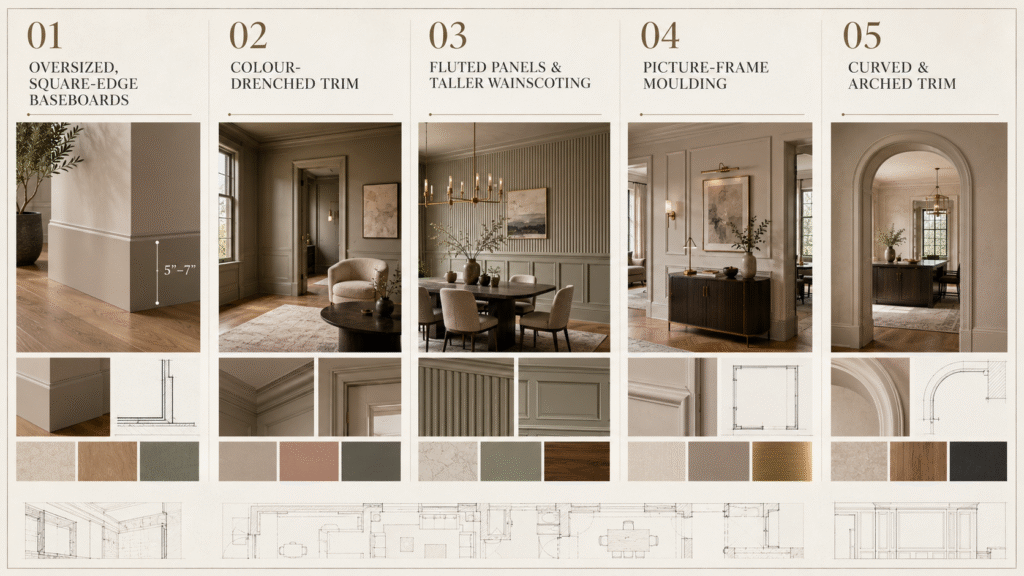
Picture-Frame Moulding, Used Sparingly
Rather than covering every wall in the house, picture-frame moulding is being used as a selective accent.
- Reserve it for one or two rooms — a dining room, hallway, or home office
- Works best when panel proportions are custom-measured to the wall, not applied off a generic template
- From a resale standpoint, expect a less predictable return than baseboards or window casings — this is a taste-driven choice
Curved and Arched Trim
Flexible polyurethane moulding has made curved casings around doorways, niches, and windows genuinely practical to install.
- Softens the hard right angles that define most contemporary rooms
- Bends without cracking, so it takes paint cleanly
- Best used around a single architectural moment rather than throughout a home
What Doesn’t Work: Moulding Mistakes to Avoid
Ornate, Builder-Grade Profiles in a Minimalist Room
Stock crown moulding with heavy scrollwork reads as generic rather than traditional when it’s dropped into an otherwise clean, contemporary space. Match the trim’s vocabulary to the room’s.
Stark White Gloss Trim Against a Warm Palette
The high-contrast white-trim look that dominated the last decade increasingly clashes with the warmer, more textural palettes now in style; a hard gloss-white line against a clay or sage wall reads dated rather than crisp.
Undersized Trim in a Tall Room
Scale mismatches are the most common moulding mistake. A standard 3-inch baseboard under a 10-foot ceiling simply disappears rather than reading as restrained. Baseboard and crown moulding should echo each other in scale so the floor and ceiling trim feel like part of one architectural idea.
Broken or Inconsistent Runs
Moulding that stops and starts inconsistently around corners, door casings, and transitions signals a cost-cutting shortcut, even when the profile itself is a good choice.
Stacking Too Many Profiles in One Room
Fluted panelling, picture framing, an arched doorway, and a heavy crown in the same space stop feeling considered and start feeling busy. Pick one or two moulding moves per room and let them do the work.
Is Moulding Worth the Investment?
The return on interior trim depends heavily on which trim you choose:
Baseboards and Window/Door Casings
The most reliably value-adding trim, since buyers notice them even without knowing why a room feels “finished”.
Crown Moulding
Can modestly boost a living room’s resale return, though it works best layered onto a room that’s already being updated rather than installed in isolation.
Decorative Trims
Wainscoting, chair rails, and picture-frame moulding cost more to install and are less predictable as a resale play, though they add real character if you’re staying put.
Material Choice
MDF is the practical standard for painted trim — it resists humidity and warping and takes a glass-smooth finish. Solid wood earns its premium only when left natural, where the grain is the point.
Frequently Asked Questions
Yes, but scaled up and simplified. The trend has moved away from ornate, decorative profiles toward larger, cleaner trims that match the proportions of the room.
Baseboards in the 5–7 inch range, with square or eased edges, are the current standard in modern builds, paired with 3.5–5.5 inch casings.
It can, particularly baseboards and window/door casings, though the effect is modest and works best as part of a broader room refresh rather than a standalone project.