
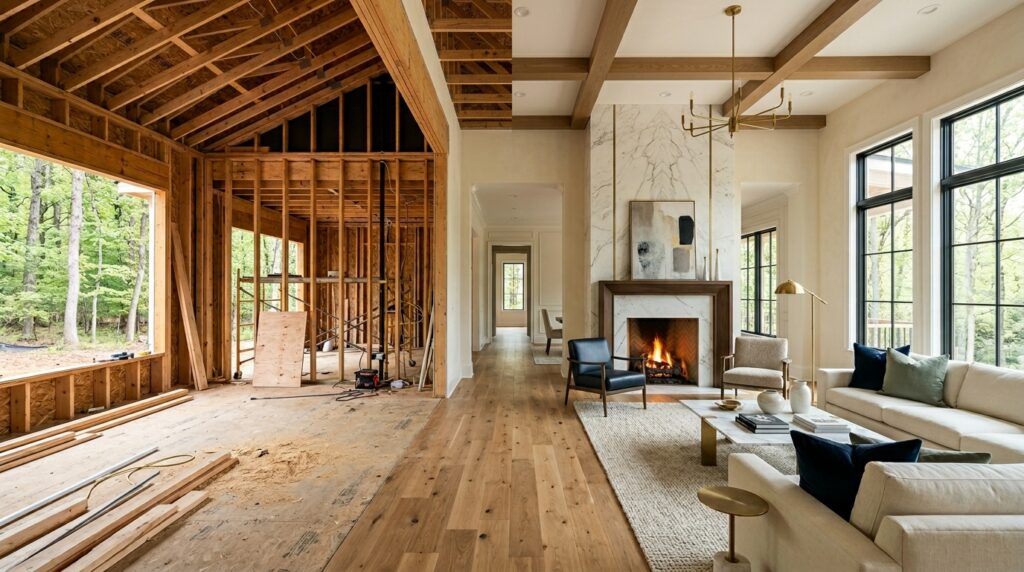
I have had this conversation more times than I can count. A client calls us three months into a new build or halfway through a gut renovation—excited, overwhelmed, and already wondering whether some of the decisions that have been made are going to work. Sometimes they will. Sometimes we are having a very different kind of conversation about what can still be changed and what has already been set in concrete—literally.
The most important thing I can tell any Virginia homeowner building new or undertaking a major remodel is this: the earlier a designer is involved, the better the result and the lower the overall cost. Not because designers are trying to expand their scope — but because the decisions that shape everything else get made in the first weeks of a project, and making them without design input is one of the most expensive habits in residential construction.
Here is what you need to understand before your project starts — whether it is a new build in Great Falls, a full-floor remodel in Arlington, or an addition to an existing home in Fairfax County. For a full picture of what professional support looks like, start with our residential interior design services.
The Difference Between New Build Design and a Standard Renovation
These two project types are often grouped under ‘remodeling design services,’ but they are fundamentally different disciplines and understanding the distinction matters before you decide what kind of design support you need.
| Factor | New Build | Standard Renovation / Remodel |
| Starting point | A blank shell—no existing layout, finishes, or constraints beyond the structural frame | An existing space with an established layout, finishes, and often an emotional attachment to certain features |
| Designer involvement | From preconstruction—influencing floor plan, ceiling heights, window placement, MEP routing | From assessment of existing conditions — working with or around what is structurally fixed |
| Key decisions | Everything: layout, flow, materials, lighting specs, built-ins—made before walls go up | Selective: which elements to retain, which to remove, and what new work integrates with the existing |
| Risk profile | Higher stakes for late decisions—changes after framing are expensive | Higher risk of scope creep—renovation reveals often uncover unexpected structural issues |
| Timeline | Tied to the construction program—design must stay ahead of the build | Dependent on contractor availability and phasing—can sometimes be done in stages |
The short version: a new build is about making the right decisions before the structure is fixed. A renovation is about making the best decisions given what the structure already is. Both benefit enormously from professional design input—but the timing and nature of that input differ significantly between the two.
When Should You Bring in an Interior Designer for a New Build?
The answer that surprises most clients: before you finalize your floor plan.
Architects design structures. Interior designers design how people live inside them. These are complementary disciplines, and the best new build results in Virginia come from projects where the two are working in parallel — not sequentially. When an interior designer reviews a floor plan before it is finalized, they catch livability issues that structural drawings do not reveal: a kitchen island that blocks natural light from the dining area, a master suite where the only logical furniture arrangement puts the bed directly in the door’s sightline, and a living room with no wall space for a sofa once the fireplace and windows are accounted for.
If you are building new, bring a designer in at the planning permission stage or immediately after, not after the slab has been poured. If you are remodeling, bring them in before you appoint your contractor so the brief and scope can be properly defined before anyone starts pricing work.
Rule of thumb: For every week a designer is involved before construction begins, expect to save multiple weeks of corrections and rework during and after the build.
The most common regret we hear from new build clients is, ‘I wish we had talked to you before we signed off on the floor plan.’ ‘Don’t be that client.
Key Design Decisions Made at Blueprint Stage
These are the decisions that cannot be revisited cheaply once construction is underway. Every one of them should be made with a designer involved, not resolved on a builder’s default or deferred until ‘we can sort that out later.’
| Blueprint-Stage Decision | Why It Cannot Wait |
| Floor plan finalisation | Room sizes, ceiling heights, door and window placement — all of these affect furniture layout, natural light, and acoustic performance in ways that are extremely expensive to change post-construction. |
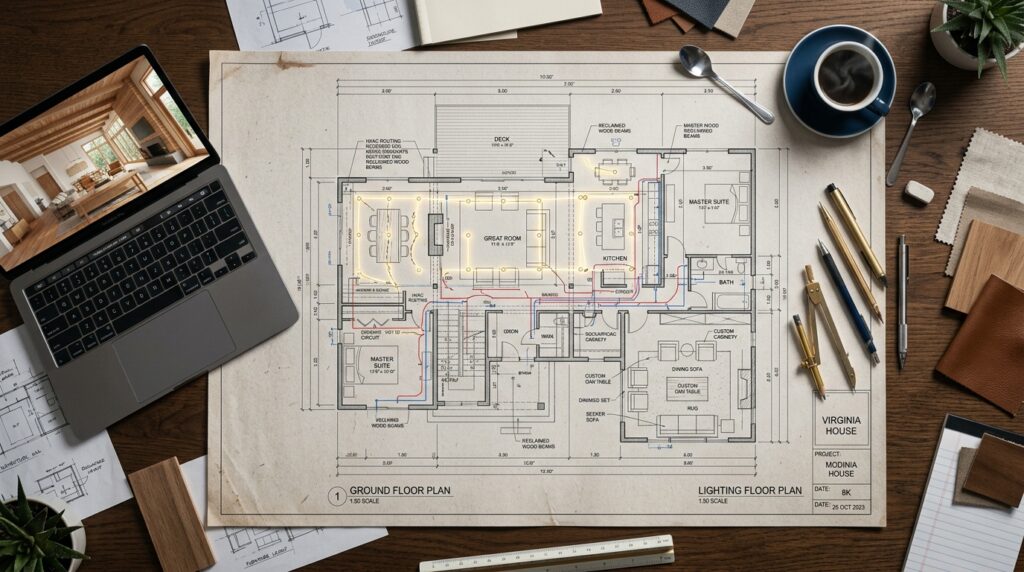
| Lighting plan | Recessed lighting positions, pendant drop points, wall sconce locations, and under-cabinet wiring must all be specified before ceilings are drywalled. Post-construction lighting changes require reopening finished ceilings. |
| Electrical and data | USB outlets, media wall prep, hidden TV cable routing, and charging station locations — all require decisions before walls are closed. Retrofitting costs multiples of what it costs to spec correctly at this stage. |
| Built-in joinery positions | Kitchen cabinetry, wardrobes, bookshelves, window seats, and bathroom vanities all have structural, plumbing, or electrical dependencies that must be planned in coordination with the build team. |
| Flooring transitions | Where different flooring materials meet—between rooms, at thresholds, at level changes—requires planning at the subfloor stage, not after the finishes are ordered. |
| Material lead times | Stone, custom tile, bespoke cabinetry, and imported finishes often carry 10–20 week lead times. These must be specified and ordered during the build phase to avoid holding up completion. |
I have seen new build projects in Northern Virginia where the lighting plan alone—done properly at the blueprint stage—saved the client more than the designer’s entire fee. Not because the lighting was expensive, but because doing it right the first time meant no reopened ceilings, no compromised positions, and no retrofit work six months after handover.
How We Coordinate with Architects and Contractors in Virginia
One of the questions I am most frequently asked is how interior design and architectural services overlap—and whether bringing in both creates duplication or conflict. In our experience, it creates neither, as long as the roles are clearly defined from the outset. You can read exactly how we structure our engagements on our How We Work page—but here is the short version.
The architect owns the structure, the envelope, and the planning compliance. We own the interior—how every room is planned, finished, furnished, and lit. On a new build, we work from the architect’s drawings and flag anything that will create a livability or design problem before it is built. On a renovation, we work alongside the contractor — providing a complete specification so there is no ambiguity about what goes where and why.
The coordination that matters most is in procurement sequencing. A well-run project has a single timeline that accounts for structural work, material lead times, specialist trades, and furniture delivery — with no stage waiting on a decision that should have been made two phases earlier. We manage that timeline as part of our service. It is not something we hand off to a contractor to figure out.
If you are in the early stages of planning a build or renovation anywhere in Virginia, our interior design services in Virginia page gives you a clear picture of how we engage, what each service tier includes, and how to take the first step.
Starting a Build or Renovation? Let’s Get Involved From the Beginning.
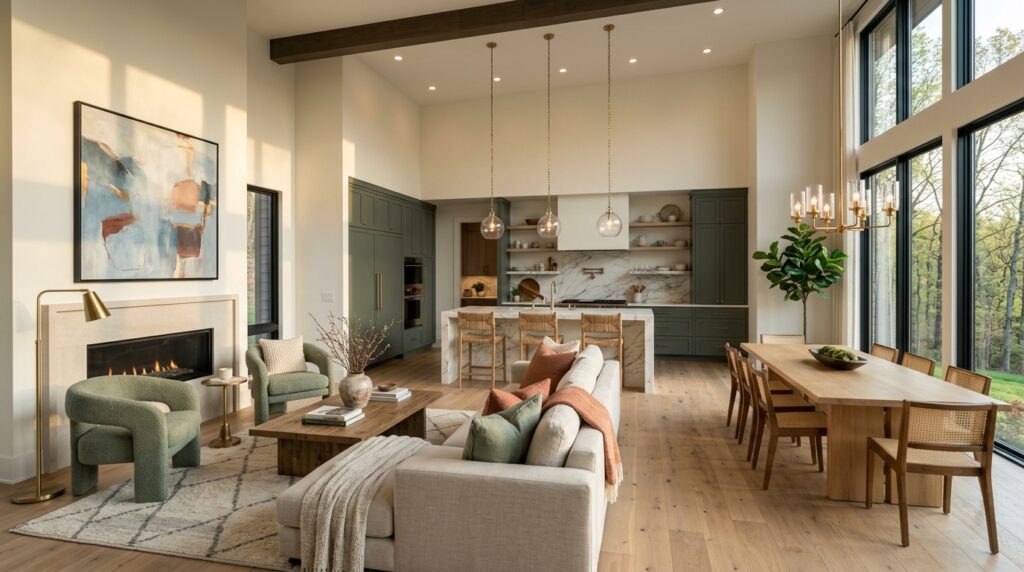
The decisions you make in the first weeks of a new build or major renovation shape every single thing that follows. Statement Design Concepts works with Virginia homeowners at every stage — from blueprint review to final styling — to make sure those decisions are made with confidence, context, and professional expertise behind them.