
Great Falls, VA, is home to some of the most generously proportioned residential properties in Northern Virginia: large lots, high ceilings, substantial square footage, and architectural character that ranges from classic colonial to contemporary custom builds. And yet, the size and quality of a home do not protect it from interior design mistakes. In many cases, a larger home means the mistakes are more expensive.
The seven mistakes below are the most common ones we encounter when homeowners in Great Falls and across Northern Virginia come to us after attempting a redesign on their own or after working with a decorator who wasn’t the right fit. Each one is avoidable. All of them are fixable. But catching them before they happen — with the right professional support from day one — saves time, money, and significant frustration. Explore our interior design services in Virginia to understand how we help homeowners avoid every one of them
.
At a glance, the 7 mistakes and what each one costs you:
| # | Mistake | What It Costs You |
| 1 | Choosing furniture before a space plan | Furniture that doesn’t fit, rooms that don’t flow |
| 2 | Ignoring natural light | Wrong finishes, flat rooms, wasted potential |
| 3 | Mixing too many design styles | Visual noise, incoherent spaces, costly restarts |
| 4 | Underestimating the power of colour | Rooms that feel off without a clear reason why |
| 5 | DIY procurement without trade access | Retail markups, limited quality, long lead times |
| 6 | Skipping the professional consultation | Avoidable mistakes compounding through the project |
| 7 | Rushing the finish selection phase | Mismatched materials, expensive late changes |
MISTAKE 1: Choosing Furniture Before a Space Plan
This is the single most common and most expensive mistake in residential interior design. A homeowner falls in love with a sofa at a showroom, buys it, and brings it home and discovers it blocks the natural traffic flow through the room, sits awkwardly relative to the fireplace, and makes the space feel smaller rather than more furnished.
Furniture selection must follow space planning, never precede it. A space plan maps traffic routes, defines zones for different activities, establishes sightlines, and determines the correct furniture scale for the room’s proportions. In a Great Falls home with large, interconnected ground-floor rooms, this planning stage is critical — the consequences of getting it wrong multiply across the entire floor.
✔ The Fix: Complete your space plan before purchasing a single piece of furniture. If you already own pieces you love, bring them into the plan — but let the plan lead.
MISTAKE 2: Ignoring Natural Light in Great Falls Homes
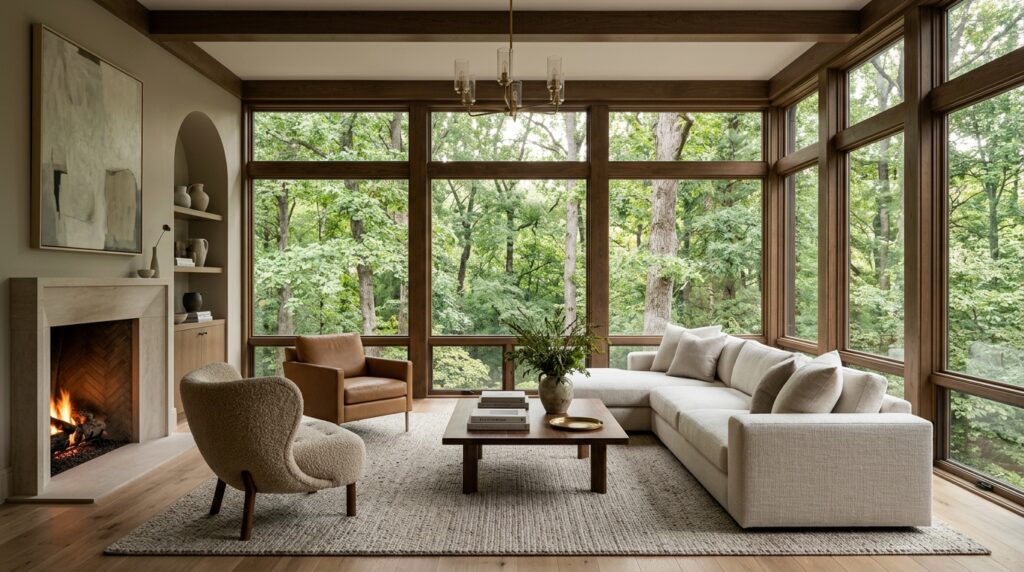
Great Falls properties often sit on heavily wooded lots, which means natural light behaves very differently here than in more open suburban neighborhoods. Morning light, afternoon shadow patterns, and the color temperature of light filtered through a mature tree canopy all affect how colors, materials, and finishes read in a room.
A paint color chosen under showroom lighting or selected from a fan deck without testing on the actual wall will look entirely different once the room is in full afternoon shadow. The same applies to fabric choices, stone finishes, and wood tones. Ignoring this is how homeowners end up with rooms that look nothing like what they imagined.
✔ The Fix: Test all paint colors and key materials in the actual room, across different times of day and under both natural and artificial light, before committing.
MISTAKE 3: Mixing Too Many Design Styles
A well-edited interior can successfully blend design references—a modern home with antique accents or a traditional base with contemporary furniture. What does not work is a room that has accumulated pieces from five or six different style directions without a unifying thread. The result is visual noise: a space that feels busy, unresolved, and impossible to accessorize or complete.
This mistake is particularly common in larger Great Falls homes where different family members have contributed pieces over time or where previous renovation phases used different designers with different aesthetic approaches. The fix is not necessarily to start over — it is to identify the dominant design language and edit everything else in relation to it.
✔ The Fix: Define one primary style direction and two complementary accents. Every piece in the room should relate to at least one of the three.
The most cohesive rooms are never the most filled ones. Restraint and editing are skills — they are exactly what a professional designer brings to a project.
MISTAKE 4: Underestimating the Power of Colour
Color is the most powerful tool in interior design and the most frequently misused. It is not just about picking a shade you like colour affects perceived room size, ceiling height, temperature, mood, and the way every other element in the room reads. A warm white makes a north-facing room feel welcoming; a cool grey in the same space makes it feel cold and uninviting.
The mistake most homeowners make is choosing color last—painting walls once furniture and finishes are already in place and hoping everything works together. Colour should be a primary design decision, not a finishing touch. In larger Great Falls homes with open-plan ground floors, getting the colour architecture right across interconnected spaces requires deliberate planning and professional colour knowledge.
The Fix: Treat colour as a structural decision, not a decorative one. Choose your palette during the design phase — before furniture orders, not after.
MISTAKE 5: DIY Procurement Without Trade Access
Sourcing furniture, materials, and finishes independently through retail — however high-end the retailer — limits you to what the public market offers. Professional interior designers have trade-only access to supplier networks that carry better quality, more customization options, longer warranties, and more competitive pricing than anything available on the high street or through consumer-facing showrooms.
*+The hidden costs of DIY procurement compound quickly: retail markups that exceed what a designer’s trade discount would have saved; delivery coordination across multiple suppliers, quality checking without professional knowledge to know what to look for, and the difficulty of returning or exchanging items once they arrive and don’t work as expected in the space.
✔ The Fix: Work with a designer who has established trade relationships. The access alone — not just the expertise — frequently offsets the design fee.
MISTAKE 6: Skipping the Professional Consultation
The professional design consultation is not the beginning of a sales process—it is a diagnostic exercise. It is where the mistakes already embedded in a project get identified, where the scope gets properly defined, and where a realistic budget and timeline get established before any money is committed to the wrong things.
Homeowners who skip this step and go straight to purchasing typically spend more — not less — over the life of the project. They course-correct after the fact, replace items that were purchased without context, and lose time managing a process they were not equipped to manage alone. Our residential interior design services begin with a detailed consultation precisely because everything that follows depends on it being done properly.
✔ The Fix: Book a consultation before purchasing anything. Even if you go on to manage the project yourself, one professional session at the outset changes the quality of every decision that follows.

MISTAKE 7 Rushing the Finish Selection Phase
Finish selection — flooring, tile, stone, paint, hardware, cabinetry — is the phase that determines the tactile and visual quality of the finished space. It is also the phase that homeowners most commonly rush, either because a contractor is pressing for decisions, a showroom appointment is set, or the project has been delayed and there is pressure to make up time.
Rushed finish selections create mismatched material stories — stone that clashes with cabinetry, flooring that competes with tile, hardware that sits in the wrong metal family. These are not small errors. They are highly visible in the finished room and extremely expensive to correct after installation. The finish selection phase deserves as much time as the furniture plan — often more.
✔ The Fix: Build finish selection time into your project schedule from the outset. Create a materials board for each space and review everything together before ordering or installing anything.
Avoid Every One of These Mistakes — Work With a Professional From Day One
Every mistake on this list is something Statement Design Concepts prevents as a matter of process. We plan before we purchase, we test before we commit, and we manage every stage so the decisions that matter get the attention they deserve. If you are planning a redesign in Great Falls or anywhere across Northern Virginia, the best time to bring us in is before anything has been decided.