
If you are renovating your home or simply upgrading a single room, one of the most stylish and practical decisions you will face is choosing between a pocket door and a barn door. Both eliminate the frustrating swing radius of a traditional hinged door. Both save floor space. Both look infinitely more intentional than a standard interior door.
But they are not the same thing, and choosing the wrong one for your space could cost you time, money, and design harmony.
In Statement Design Concepts, we encounter daily homeowners who have to make this exact choice. This article provides you with everything you need to know about the matter, from price to installation to privacy and maintenance, and down to which door is better suited for what circumstances.
What Is a Barn Door?
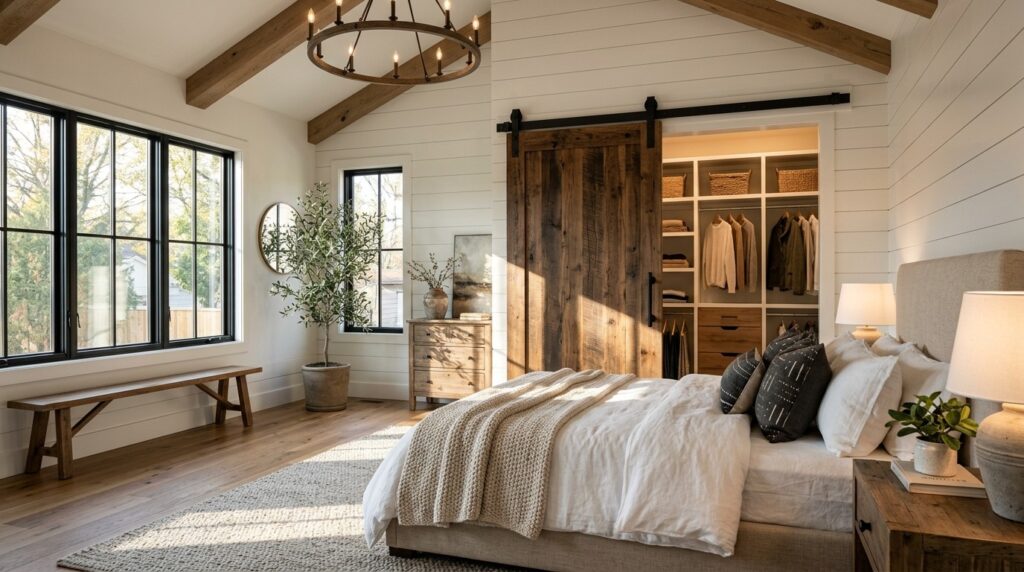
A barn door is a sliding door mounted on a track fixed to the outside of your wall. Inspired by the large sliding doors on agricultural barns, today’s interior barn doors come in everything from reclaimed timber and painted MDF to frosted glass and black metal, far removed from their rustic origins.
When open, a barn door slides across the adjacent wall. When closed, it covers the doorway. The track, hardware, and rollers are all visible and become part of the room’s design aesthetic.
Best for: Bedrooms, pantries, living rooms, home offices, closets.
What Is a Pocket Door?
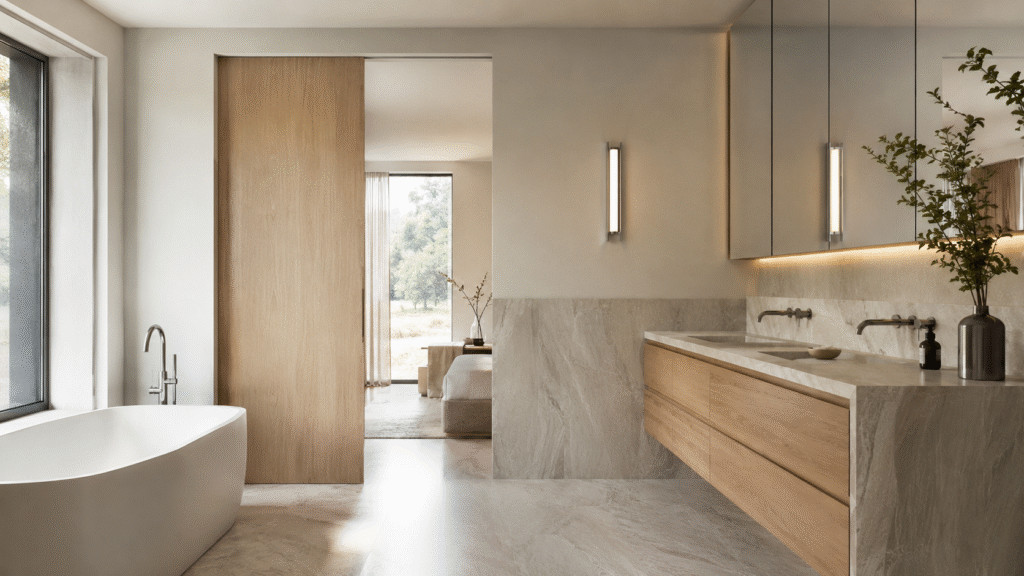
The pocket door opens into a secret space that is concealed in the very walls themselves. Once opened, it vanishes completely, allowing the doorway to remain clear and the wall untouched.
There is no track at all; there is nothing to obstruct the door opening.
This gives you a minimalist look that other doors cannot replicate.
Ideal for: Bathrooms, en-suite bathrooms, hallways, small spaces, and open-plan areas.
Pocket Door vs Barn Door: The Full Comparison
1. Space Efficiency
Both doors eliminate swing clearance, which is the 10 square feet a traditional hinged door wastes every time it opens. But they handle space differently. If you are still exploring all your options beyond these two, we have covered every space-saving door style worth considering in a separate guide.
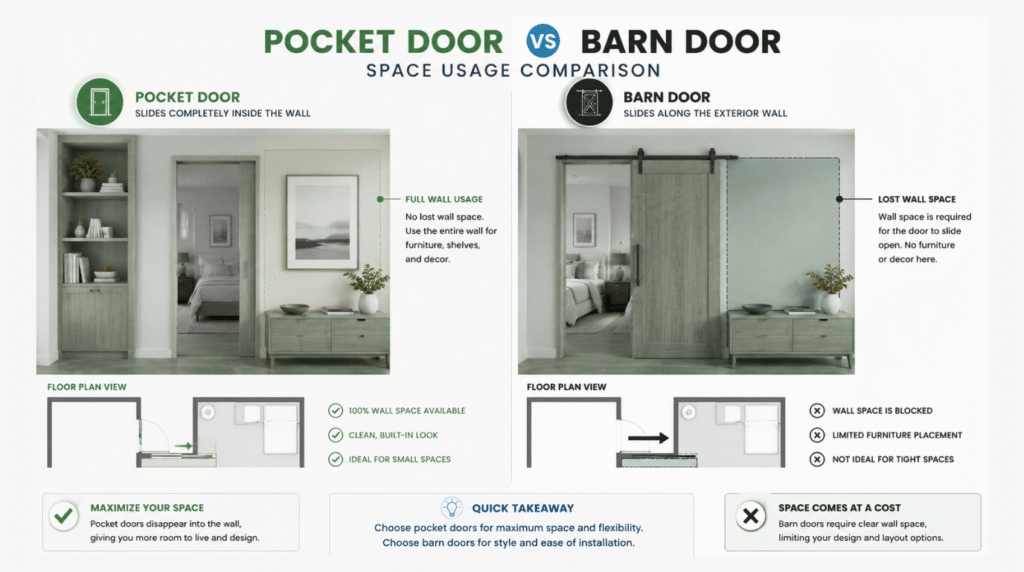
A pocket door disappears entirely into the wall, freeing up both floor space and the adjacent wall space. You can place furniture, hang artwork, or install shelving right up to the doorway on either side.
A barn door saves floor space but requires clear wall space beside the doorway, at least the full width of the door, for it to slide open. No shelves, no switches, no artwork in that zone. To plan the opening correctly, check the standard door size for residential homes first.
Winner: Pocket Door. For maximum space efficiency, nothing beats a door that vanishes into the wall.
2. Cost of Pocket Doors vs Regular Doors and Barn Doors
This is where things get interesting and where many homeowners are surprised.
Barn Door Cost:
- Door + hardware materials: $250 to $2,500
- Professional installation: $575 to $1,800 total (including materials and labor)
- DIY installation: $300 to $800 (most homeowners with basic skills can do this themselves in 3 to 4 hours)
Pocket Door Cost:
- Door + frame kit: $400 to $1,000
- New construction installation: $550 to $3,300 total
- Retrofit into existing wall: $1,400 to $4,200 total (wall must be opened, studs cut, utilities potentially rerouted)
So are pocket doors more expensive than regular doors? Yes, significantly. A standard hinged door costs just $150 to $200 to install. A pocket door retrofit into an existing wall can cost up to 20 times more.
And compared to barn doors, pocket doors are consistently more expensive to install, even though the door unit itself may cost less. The complexity of building a wall cavity, rerouting wiring, and finishing the wall afterward drives the price up considerably.
Winner: Barn Door. Lower total installation cost, DIY-friendly, and no wall modification required.
3. Privacy and Sound Control
This is one of the most important factors for most homeowners, and the two doors differ significantly.
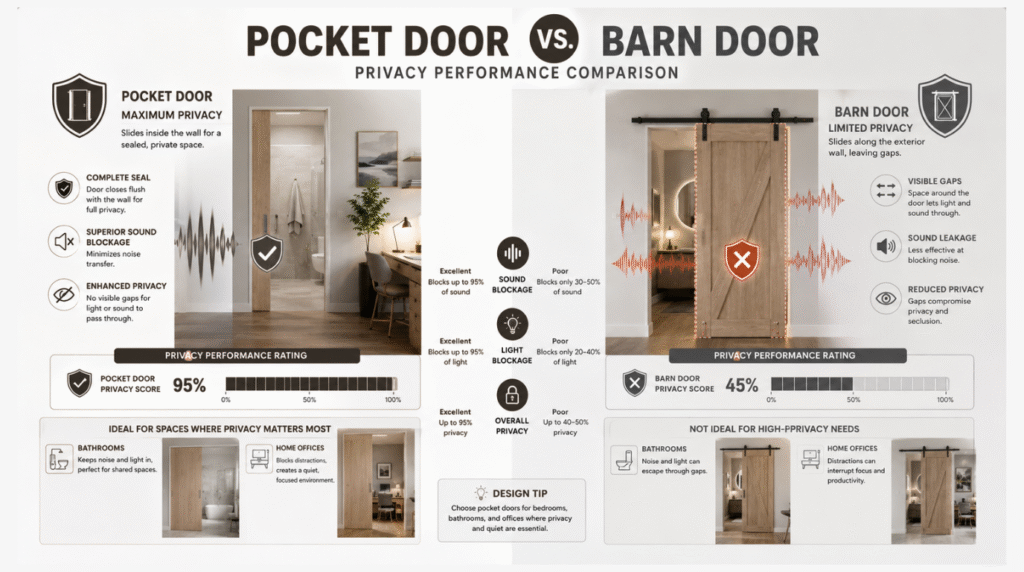
Since pocket doors slide flush into the frame of the wall, they seal shut on three sides, making it easier to create a seal that is much more effective than the one created by barn doors. They have a sound transmission class rating of 35-45, which indicates that they effectively prevent noise.
Barn doors mount on an external rail, which makes it impossible to avoid small spaces between the door and the walls around the door. Noise, light, and other things like smell may penetrate through these openings. They have an STC rating of 20-30.
Winner: Pocket Doors. If you need a door that offers privacy and prevents sound from getting through, pocket doors are the best option.
4. Installation Complexity
Barn doors are one of the most accessible home improvement projects available. The track mounts on the outside of the wall into existing studs. No demolition. No wall opening. Specialist trades are not needed. Roughly 85% of homeowners can install a barn door on their own in 3 to 4 hours.
Pocket doors involve considerable alterations to the building structure. The neighboring wall has to be demolished, studs have to be sawn out or taken out, a new framework and a track mechanism have to be put into the space left open, and then the wall has to be built up again and painted over. If there are any utilities such as wiring, pipes, or vents in the wall, these also have to be rerouted.
Winner: Barn Door, no contest. More economical and much easier to install.
5. Maintenance
Barn doors are the clear winner here. Since everything, including the track, rollers, and guides, is placed externally from the wall, everything is easy to access. Cleaning, oiling, repairing, and adjusting are simple tasks that even an average homeowner can do.
The pocket doors have their hardware stored in the walls. In case the rollers get worn, the track gets warped, or the door is detached from the guide, repairing the door will require opening the wall first. Simple repairs may cost $100-$200; replacing the rollers can be $200-$400; and replacing the track may go up to $600-$1,200.
Winner: Barn Door. Maintenance is quick, easy, and cheap.
6. Design and Style
Both have come a long way from the early designs and fit into many modern interior decorating schemes.
Barn doors are assertive designs. The exposed track, rolling wheels, and exposed hardware give a barn door an architectural quality, which becomes the centerpiece of the room. These doors can be found in designs using reclaimed wood, painted MDF, glass, chalkboards, and metals and thus work well with farmhouse, industrial, Scandinavian, and contemporary interior designs. To see some other design ideas that will give you creative door ideas, check out these chic interior door ideas that will help take your barn doors to another level.
Pocket doors are subtle designs. When opened, there is nothing there. And when closed, all one sees is the door itself that matches the rest of the walls. Such a feature works great in minimalistic interior designs where every single visual component counts. Also, frosted glass pocket doors will let some light go through them while still keeping the room private.
At Statement Design Concepts, our view is this: if you want your door to be a design feature, choose a barn door. If you want your door to disappear and let the rest of the room speak, choose a pocket door.
Winner: Tie. Both are beautiful, with different aesthetic intentions.
7. Best Use Case by Room
| Room | Best Choice | Why |
| Master Bedroom | Barn Door | Style impact, lower cost, easy install |
| En-Suite Bathroom | Pocket Door | Better privacy, flush seal, no wall space needed |
| Small Bathroom | Pocket Door | Disappears completely, maximizes space |
| Pantry | Barn Door | Easy access, decorative, no privacy needed |
| Home Office | Barn Door or Pocket | Depends on sound privacy needs |
| Hallway | Pocket Door | No adjacent wall space wasted |
| Living Room Divider | Barn Door | Statement piece, easy to open fully |
| Walk-in Closet | Either | Barn for style, pocket for seamless finish |
| Studio Apartment | Barn Door | Easier install, works as a room divider |
The Honest Verdict
Choose a barn door if:
- You want a bold design statement
- Budget is a consideration
- You are comfortable with a DIY install
- The space does not require high sound privacy
- You want flexibility to change the door later
Choose a pocket door if:
- You need maximum privacy and sound control
- The room is very small, with no adjacent wall space
- You are building new or doing a full renovation (retrofit is costly)
- You want a completely seamless, minimalist finish
- Long-term invisibility matters more than design impact
Pocket Door vs Sliding Door: Is There a Difference?
One of the questions we get asked frequently is, “What is the difference between a pocket door and a sliding door?”
In technical terms, both barn doors and pocket doors can be classified as sliding doors since they slide along a track instead of opening like swinging doors. “Sliding doors” is the general term. Under sliding doors, pocket doors slide in the wall, whereas barn doors or sliding barn doors and bypass doors slide on the exterior of the wall.
Final Thoughts
The pocket door vs barn door debate does not have a single right answer. It has the right answer for your space, your budget, and your design vision.
Barn doors win on cost, installation ease, and design impact. Pocket doors win on privacy, space efficiency, and minimalist elegance. Understanding those differences is what leads to a decision you will love for years to come.
Still not sure which direction to go? Sometimes the best solution is neither. Our guide on alternatives to traditional interior doors explores 10 options, including curtains, glass partitions, bi-fold doors, and open shelving, all with cost and privacy comparisons.
Ready to transform your interiors with the right door solution? Explore our full range of interior design services and inspiration at SDC, where every design choice is made with intention.